
NO SMOKING
A film about the Indian Censor Board
"Walking into that rehab center felt like stepping into a place where the air itself was trying to suffocate me"

Introduction to the story
In a Film where A man becomes fixated on cigarettes, believing they bring him happiness and comfort. Symbolizing his quest for personal pleasure, his addiction grows while he remains blind to its harmful effects. As his obsession intensifies, it begins to destroy not only his own life but also negatively impacts those around him. The film reveals the tragic irony of how what he thought was a source of joy becomes a source of pain and ruin for both himself and society.
The Storyline
Anurag Kashyap's film "No Smoking" crafts a unique and immersive world that blends psychological drama with dark, surreal elements. Set in an unnamed city that mirrors a distorted reality, the film explores themes of addiction and personal struggle through its meticulously designed environment. The world Kashyap builds is both haunting and captivating, reflecting the protagonist’s internal chaos and the societal pressures surrounding him.
The storyline follows John (played by John Abraham), a successful, chain-smoking businessman who becomes entangled in a surreal and nightmarish journey to quit smoking. His life is upended when he is coerced into seeking help from a mysterious and ominous rehabilitation center, which promises to cure his addiction through unconventional and unsettling methods.
As John delves deeper into the center’s bizarre and disturbing therapies, the line between reality and hallucination blurs. The film’s narrative cleverly employs a Kafkaesque atmosphere to illustrate John’s descent into a psychological labyrinth where every attempt to escape his addiction leads him further into a nightmarish world. The plot intertwines with visual metaphors and dark humor, creating a rich tapestry that questions the true nature of freedom and the cost of obsession. Kashyap’s world-building emphasizes the protagonist’s struggle with both internal demons and external expectations, crafting a thought-provoking exploration of addiction and personal transformation.
In Anurag Kashyap’s film "No Smoking," the protagonist, John (played by John Abraham), embodies the complex interplay between addiction and personal turmoil. John is a successful businessman whose life is dominated by his obsession with cigarettes. His addiction is not just a physical craving but a psychological dependence that consumes him. This obsession leads him to seek help from a mysterious rehabilitation center, plunging him into a surreal and harrowing journey.
John's relentless smoking mirrors Kashyap's own obsession with pushing the boundaries of conventional filmmaking. Just as John is drawn into a labyrinth of bizarre and unsettling experiences in his quest for freedom from nicotine, Kashyap's narrative reflects his own drive to explore unconventional and thought-provoking themes in cinema. The film’s dark humor, surreal sequences, and psychological depth highlight Kashyap’s passion for crafting narratives that challenge traditional storytelling.
Kashyap’s fixation on creating films that break away from mainstream norms is mirrored in John's descent into a nightmarish world where his struggle with addiction becomes an allegory for the director's own creative battles. The protagonist’s journey underscores Kashyap’s commitment to producing innovative, boundary-pushing cinema that confronts complex and often uncomfortable truths.

The Protagonist
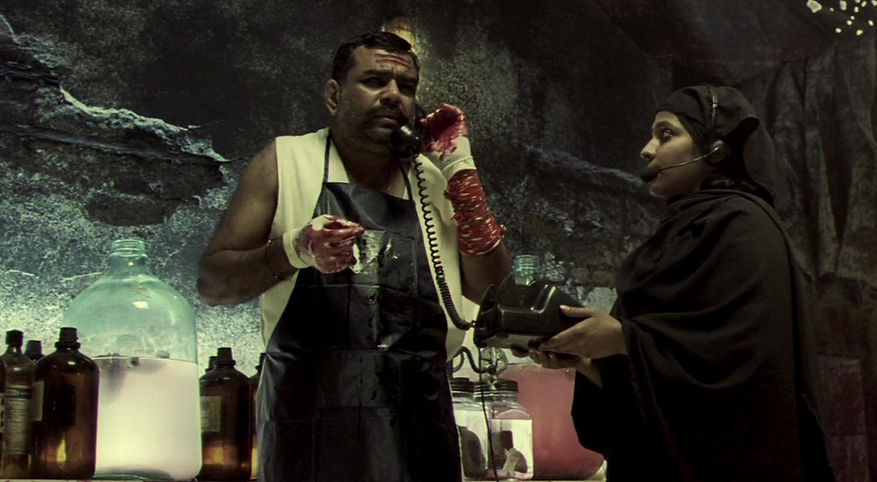
The Rehabilitate Centre

The protagonist John and the enigmatic rehabilitation center serve as powerful metaphors for the director’s own creative struggles and the broader conflicts between artistic freedom and institutional constraints. Through the lens of John’s obsession with cigarettes and his harrowing journey through the rehabilitation center, Kashyap constructs a compelling allegory about the tension between personal expression and external pressures.
John, portrayed by John Abraham, is a successful businessman whose life is overshadowed by his addiction to cigarettes. This obsession is not merely a physical dependence but a deeply ingrained part of his identity and personal comfort. The cigarettes symbolize more than just a habit—they represent John’s sense of autonomy, his way of coping with the pressures of his professional life, and a personal rebellion against societal norms. His struggle to quit smoking becomes a central theme in the film, mirroring a larger existential conflict.
The rehabilitation center John is coerced into represents a broader societal and institutional force. It is portrayed as an oppressive and Kafkaesque institution that uses unorthodox and disturbing methods to force individuals to abandon their habits. This center, with its surreal and almost sinister approach, symbolizes the censoring bodies and mainstream expectations that attempt to dictate the terms of artistic expression. Just as the center demands that John relinquish his cigarettes, it can be seen as a metaphor for the pressure Kashyap faces from external forces—particularly the censorship boards and critics—who seek to control or constrain his creative freedom.
In this context, the cigarettes become a powerful metaphor for Kashyap’s artistic freedom and his desire to push the boundaries of conventional cinema. The film’s portrayal of John’s struggle reflects Kashyap’s own creative battles against forces that seek to restrict his ability to express his vision fully. The censorship board, much like the rehabilitation center, aims to curb Kashyap’s distinctive cinematic style, which often explores controversial themes and unconventional narratives. The film’s narrative thus becomes a commentary on the constraints imposed on artistic freedom and the cost of conformity.
As John navigates the surreal and often disturbing environment of the rehabilitation center, his journey reflects Kashyap’s struggle against the forces that seek to limit his creative expression. The center’s extreme methods and the increasingly nightmarish experiences John endures symbolize the often harsh and unreasonable demands placed upon filmmakers who challenge the status quo. The film portrays the protagonist’s fight to reclaim his freedom, highlighting the broader theme of resistance against forces that seek to suppress individuality and innovation.
In essence, "No Smoking" uses John’s addiction and the rehabilitation center as metaphors for the broader conflict between creative freedom and institutional control. The cigarettes, emblematic of Kashyap’s personal and artistic autonomy, become a battleground where the director’s struggle for self-expression is tested against external pressures. The film ultimately serves as a poignant exploration of the tension between personal freedom and societal constraints, reflecting Kashyap’s own experiences and challenges within the realm of cinema. Through this allegory, Kashyap crafts a narrative that is both a personal reflection and a universal commentary on the cost of artistic integrity in the face of institutional demands.
Anatomy of the Shots

AEC Meeting
This striking AEC setting in the fusion timeline illustrates our limited understanding of Oppenheimer's transformation after World War II. From Strauss's perspective, Oppenheimer appears almost messianic, elusive, and difficult to reach. The camera's distant placement further underscores our remoteness from fully comprehending his character at this point in the film.

Poisoned Apple
The poisoned apple symbolizes the dual nature of Oppenheimer's creation: while it represents the groundbreaking and transformative potential of his work, it also signifies the inherent danger and destruction it brings to humanity.

The Father and The Son
The contrasting color of the background visually signifies that Oppenheimer and his knowledge—leading to the invention of the atomic bomb—exist on a different plane of reality. It underscores his preoccupation with his scientific pursuits over the people, emotions, and trends of his time.

The Nuclear Age
If I had to choose one shot as the most aesthetically pleasing in the entire black-and-white filmography, this would be the most beautiful black-and-white shot in the world.

The Fate of the World
This shot was my favorite from the entire film: it shows two of the most brilliant scientists in nuclear and quantum physics coming together to exchange their thoughts while observing the most dangerous weapon being transported in a truck for the war.
Ending of the Film

"I BELIEVE WE DID"
When taken at face value, the ending of Oppenheimer offers a final glimpse into the troubled mind of the Father of the Atomic Bomb. It reveals a chilling vision of humanity having opened a Pandora's Box that can never be closed, setting in motion, as he tells Einstein, a chain reaction that threatens to annihilate the entire world. It all began when Oppenheimer lost control of his ambition. I believe this has become a recurring theme in Nolan's characters: the inevitable reckoning between grandiosity and reality. They come to realize that the forces they thought they understood and could control are, in fact, controlling them, leaving them trapped in their own creations. The same holds true for Oppenheimer.
By the end, Oppenheimer grasps the full impact of his actions—he has unleashed the most dangerous weapon on humanity. His soul is condemned to suffer the weight of the regrets and guilt from creating the atomic bomb. Similarly, the audience understands that they are living in the apocalyptic reality envisioned by 20th-century scientists who believed there was a world beyond Newton's laws of physics.
Thus, there is no post-credit scene, but if someone were to ask you, as an audience member, you could simply say that we are living in it.
Promethean Horror

After the war, Oppenheimer found himself increasingly alienated from his own work, struggling to understand the suddenly unfamiliar world around him as well as the turmoil within. Where once everything was neatly compartmentalized—work, family matters—now, all boundaries were dissolving, engulfing everything in an uncontrollable blaze. Instead of mastering the quantum realm, Oppenheimer seemed to have unleashed it, both upon the world and upon himself, dooming both in the process.
Oppenheimer is acutely aware that he is trapped in an unending cycle. He can see clearly the chain reaction he set in motion and the inescapable prison he has constructed around himself, one that he is condemned to experience repeatedly. Each time, he will reconstruct his world, relive his youth, passion, and hope, only to watch it all crumble and despair in the ruins once more.
Bilge Ebiri points out the wondrous visions of secret worlds hidden in the raindrops have been completely replaced by apocalyptic nightmares of horror and devastation. Instead of envisioning the astonishing connection between all matter and even all human relations, now sees total Annihilation.
"In his mind at least, he has destroyed the world; He has destroyed his world, his very conception of reality"